How Natural Essential Oils
Transform Your Horse's Coat
There's a difference between a coat that looks shiny and a coat that is healthy. One washes off in the rain. The other builds week after week, from the skin outward. Here's the science behind which one you're actually creating.
Every horse owner has had this moment. You spray something on before a ride, buff it out, and your horse gleams. Genuinely gleams. Then two weeks later the coat looks worse than it did before you started: dull, a bit dry, maybe a little brittle at the ends of the mane.
Here's what almost nobody explains: those two things are connected. The shine and the dullness that follows it are not unrelated events. In a lot of cases, one is causing the other.
This post is about the difference between coating a coat and conditioning one, and why that distinction determines whether your horse looks better in three months or worse.
01 Shine Isn't a Product. It's a Biological Output.
Before we talk about any ingredient, it's worth understanding where shine actually comes from, because once you know, the rest of this makes obvious sense.
Your horse's skin produces sebum. It's a natural oil secreted by glands sitting at the base of every hair follicle, and it does several jobs at once: it waterproofs the coat, keeps the hair shaft flexible rather than brittle, protects against microbial invasion, and coats each strand in a thin, even layer that reflects light.
That reflection is shine. Real shine, the kind that catches the eye across a warm-up ring, is sebum evenly distributed along healthy hair, on skin that's functioning properly. If you want the seasonal version of this, our May skin check covers what post-shedding skin needs specifically.
This means every grooming decision you make falls into one of two categories: it either supports that system or it substitutes for it.
A product that supports the system feeds the skin and hair so the horse produces better shine on its own. A product that substitutes for it applies an artificial coating that mimics shine while the underlying system stays exactly as compromised as it was. Both look similar on day one. They look nothing alike in month three.
02 The Silicone Problem: Why "Shiny" and "Healthy" Aren't the Same Thing
Most conventional coat sprays and polishes work through silicone. It's effective at what it does: silicone coats each hair shaft in a synthetic film that reflects light, reduces friction during combing, and helps repel dirt.
The problem is what that film does over time.
Dr. Rosanna Marsella, a veterinary dermatologist, is direct about it. Silicone is common in hair polishes and conditioners, and it tends to dry the hair shaft and skin. It creates a coated layer above the hair that makes it appear shiny and feel soft, but much like a varnish, it also prevents the coat from absorbing moisture. With excessive use, the hairs become weak and are easily damaged and broken.
That is worth reading twice, because it contains the entire argument in three sentences.
The coating that creates the shine is the same coating that blocks moisture from reaching the hair. So the horse looks better and the hair gets progressively weaker, at the same time, from the same product.
"The shine created by silicones can give the illusion of healthy hair while potentially aggravating existing hair problems."
There's a secondary issue too. That film doesn't just sit on hair; it sits on skin. A silicone barrier can trap bacteria, impurities, dirt, and sebum against the skin, which reduces the skin's ability to breathe and sweat properly and can drive long-term dryness and irritation.
For a horse in work, sweating under tack, in a rug, through summer, that matters far more than it does for a horse standing in a field.
The buildup cycle
Silicone is water-repellent by design, which means normal washing struggles to remove it. It accumulates. The standard fix is a strong clarifying shampoo, and that strips natural oils along with the silicone, leaving the coat drier than it was before.
So you reach for the coat spray again. That is the cycle, and it's why a lot of horses look wonderful for one afternoon and mediocre for the rest of the season. It's also why European stables approach coat care so differently, which we covered in The Danish Perspective.
03 What Oil-Based Grooming Does Differently
Natural carrier oils work through an entirely different mechanism. Rather than forming a barrier on top of the hair, they're absorbed into the hair shaft and the skin beneath it.
This is why oil-based products behave the opposite way over time. Silicone gives you the best result on day one and declining results after. Oils give you a modest result on day one and a compounding one every week after that, because you're not applying shine, you're improving the tissue that produces it.
Here's what each oil in the SHE Coat Spray formula actually contributes.
Jojoba Oil
Simmondsia chinensisJojoba is the most interesting ingredient in the formula, and it's technically not an oil at all. It's a liquid wax ester. That distinction matters enormously, because its molecular composition is remarkably close to the natural sebum that skin produces on its own.
Because the structure is so similar, jojoba absorbs readily rather than sitting on the surface, and it can help regulate the skin's own oil production rather than overriding it. On a horse with dry, under-producing skin, it supplements. On a horse with an oily, over-producing coat, it helps signal the skin to normalise. It is the closest thing in natural grooming to a self-correcting ingredient.
Absorbs without greasiness · supports the skin's natural sebum balance · non-clogging · anti-inflammatory on irritated skin · builds genuine shine rather than surface gloss
Sesamum Indicum (Sesame) Oil
Sesamum indicumThis is a lightweight carrier oil with a small enough molecular structure to penetrate the dense layers of hair and skin rather than resting on top. It also carries natural antibacterial properties, which means it contributes to skin health while it conditions. That matters for any horse dealing with recurring surface irritation, rain rot, or the kind of low-grade skin issues that quietly flatten coat quality.
Deep penetration into hair and skin · natural antibacterial support · non-greasy conditioning · supports skin barrier integrity
Fractionated Coconut Oil
Cocos nucifera"Fractionated" means the long-chain fatty acids have been removed, leaving only the lighter medium-chain triglycerides. The result is an oil that stays liquid at any temperature, absorbs faster than whole coconut oil, and doesn't go rancid or leave a heavy residue. It is the workhorse carrier, the ingredient that helps everything else move into the hair rather than sitting on it.
Rapid absorption · carries essential oils into the hair shaft · lightweight and non-greasy · stable in heat and cold
Castor Oil
Ricinus communisCastor oil is thicker and heavier than the others, and that is deliberate. Its high ricinoleic acid content is what gives it a long history in hair care specifically. It coats the hair shaft in a way that improves flexibility and reduces mechanical breakage, and it's particularly valued for mane and tail work where hair strength matters more than lightness.
Adds strength and flexibility to the hair shaft · reduces breakage during combing · supports mane and tail condition · improves slip for detangling
Grapeseed Oil
Vitis viniferaGrapeseed is one of the lightest carrier oils available, high in linoleic acid and vitamin E. It is what keeps the overall formula from feeling heavy, delivering conditioning benefit with almost no perceptible residue. That is the whole reason a coat spray can be used daily without buildup.
Extremely light texture · high in vitamin E and antioxidants · conditions without weight · suitable for daily use
The Natural Essential Oil Blend
Therapeutic-grade botanical extractsThe carrier oils do the conditioning. The essential oils do the active work: antimicrobial support at the skin surface, plus the aromatic compounds that make the product pleasant to use on a horse that has to stand still while you apply it. Essential oils are also where the concentration question matters most, because a formula built on a genuine therapeutic concentration behaves very differently from one where the oils are a fragrance afterthought.
Antimicrobial support at the skin surface · aromatic compounds horses tolerate well · works with the carrier oils rather than against them
04 The Supporting Cast: Four Ingredients Doing Quiet Work
The oils get the attention, but four other ingredients in the formula are doing specific jobs that the oils cannot do alone.
- Witch Hazel is a natural astringent that helps the formula absorb cleanly rather than pooling on the surface. It also has mild anti-inflammatory properties, which is why it appears in so many products designed for sensitive or reactive skin.
- Aloe Vera is soothing and hydrating at the skin level. Aloe is what makes a formula tolerable on skin that's already irritated by girth rubs, insect bites, or the general friction of a working season.
- White Distilled Vinegar is the ingredient people question most, and it does more than you'd think. Vinegar helps balance skin pH and, critically for shine, helps flatten the hair cuticle. A flat cuticle reflects light evenly. A raised one scatters it. This is the same principle behind vinegar rinses in human hair care, and it works for the same reason.
- Coconut Glycerine is a humectant. It draws moisture from the air into the hair and skin and holds it there, which keeps the coat from drying out between applications rather than only at the moment of application.
A common misunderstanding is that a natural product should be "all oil." It shouldn't. Pure oil on a coat is greasy, attracts dirt, and doesn't spread evenly. The distilled water and vinegar carry the oils into an even, fine application, which is what allows a genuinely oil-based product to feel non-greasy on the horse. The separation you see in the bottle is a feature of that, because there are no synthetic emulsifiers holding it together artificially. Shake before use.
05 How Oils Draw Dirt to the Surface
This is the mechanism that surprises people most, because it sounds backwards. Oil should attract dirt, shouldn't it?
Not quite, and the reason comes down to a basic chemistry principle: like dissolves like.
Most of what sits on a horse's coat is oil-soluble rather than water-soluble. That includes dust bound in sebum, sweat residue, and the greasy film that accumulates on a coat between baths. It's precisely why hosing a horse off doesn't fully clean them, and why a dry brush pushes dirt around rather than lifting it out.
When you apply a carrier oil to that coat, the fresh oil dissolves and binds the old, oxidised, dirt-laden oil already sitting on the hair. It lifts the grime away from the skin and holds it in suspension in the coat, which is exactly where your brush can reach it.
- Apply the coat spray evenly over the body. The oils begin binding the accumulated grime on and around the hair.
- Give it 30 to 60 seconds. This is the step most people skip. The oils need contact time to dissolve what's already there.
- Brush firmly in the direction of hair growth. You're not brushing dirt off dry hair; you're brushing off dirt that's now suspended in a medium your brush can actually remove.
- Finish with a soft cloth. This takes the final layer off and lays every hair flat in the same direction, which is what produces the light-reflecting surface.
The practical upshot is that a coat spray used correctly is a cleaning step, not just a finishing one. Horses on a consistent oil-based routine genuinely need bathing less often, and that matters, because every bath strips the sebum you're trying to build.
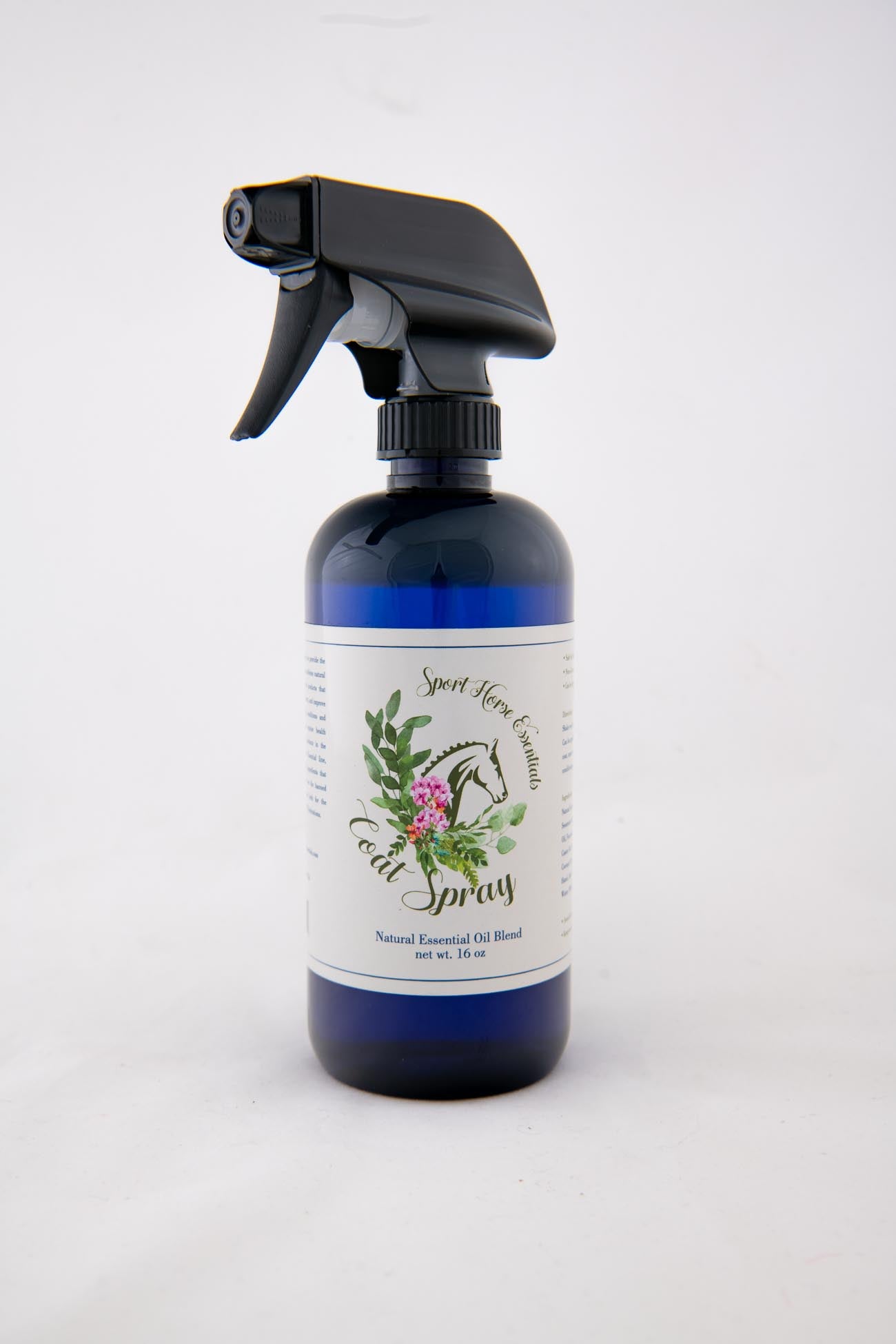
Jojoba, sesame, fractionated coconut, castor, and grapeseed oils in a witch hazel and aloe base. No silicone. No petroleum. Absorbs into the hair and skin rather than coating over them. Safe on a wet or dry coat.
Shop Coat Spray →06 Manes and Tails: You Don't Have a Growth Problem
This section could change how you groom, so it's worth reading carefully.
Body hair and mane and tail hair are biologically different. Body hair sheds twice a year and regrows, which makes it temporary hair. The mane and tail are permanent hair, along with the feathers and eyelashes.
Permanent hair grows slowly and holds for a long time. That means when a tail looks shorter this year than it did last year, the horse has not stopped growing hair.
"If your horse's mane keeps thinning or the tail looks shorter every month, the issue is rarely growth. It is almost always breakage."
Here's the part that stings: most breakage happens during grooming, not turnout. Dry brushing, rushing through knots, and working the same section repeatedly snaps hairs at mid-length, day after day.
That reframes what a detangler is actually for. It is not a convenience product. It is the thing standing between your brush and permanent hair loss.
What natural oils do for mane and tail specifically
- They add slip. A knot with adequate lubrication releases. A dry knot resists, and the hair snaps rather than the knot giving way. This is the single biggest factor in tail length retention.
- They restore flexibility. Brittle hair breaks; supple hair bends. Castor and jojoba both improve the hair shaft's ability to flex under tension rather than fracture.
- They condition the skin at the root. Hair is only as strong as the follicle it grows from. Dryness, buildup, and irritation at the crest weaken new growth before it ever reaches length.
- They avoid the silicone trap. Silicone detanglers work by coating, which reduces friction now while drying the hair shaft over time. That is a trade that costs you length across a season.
07 Natural vs. Synthetic: The Honest Comparison
Here's the side-by-side, without the marketing gloss on either side.
| Factor | Silicone-Based Spray | Oil-Based Natural Formula |
|---|---|---|
| Mechanism | Coats the hair shaft in a synthetic film | Absorbs into the hair shaft and skin beneath |
| Day-one result | Immediate, dramatic high-gloss shine | Noticeable but more modest improvement |
| Result over 12 weeks | Diminishing, with buildup, dryness, and increasing breakage | Compounding, as coat quality genuinely improves |
| Effect on skin | Barrier can trap sebum, bacteria, and moisture against skin | Conditions skin; supports natural barrier function |
| Moisture | Blocks absorption, so hair cannot rehydrate through the film | Delivers and holds moisture in the hair shaft |
| Buildup | Accumulates; requires clarifying shampoo to remove | No buildup, because it is absorbed rather than deposited |
| Saddle area | Slippery, so most brands warn against use under tack | Absorbs in; safe to use on the saddle area |
| Breakage over a season | Hairs weaken with excessive use and break more easily | Improved flexibility reduces mechanical breakage |
The honest summary is this. If you need one horse to look spectacular in the next 20 minutes and you'll deal with the consequences later, silicone wins. If you're managing a coat across a season, whether that's for the ring, the trail, or simply because you'd like your horse to look and feel well, the oil-based approach wins by a distance, and the gap widens the longer you run it.
08 Competition Compliance: What Actually Matters
If you compete at any level, from local schooling shows upward, this section needs a more careful answer than most brands give it. If you don't, feel free to skip ahead, because nothing here affects a horse that never sees a testing barn.
Here's the thing worth knowing: "natural" does not automatically mean competition-safe. That's a genuine misconception, and it catches people out. Certain botanical ingredients, including chamomile and lavender, both common in calming products, appear on prohibited lists precisely because they can have a physiological effect.
The FEI maintains an Equine Prohibited Substances List covering both Banned Substances and Controlled Medications, and USEF operates its own parallel rules. Under both, responsibility sits with the person responsible for the horse rather than with the manufacturer.
That brings us to the point that actually matters for a grooming product.
It isn't "is this product natural?" It's "can I read and identify every single ingredient in it?" A formula with a fully disclosed ingredient list can be checked against the prohibited list. A formula with "proprietary blend" or "fragrance" on the label cannot. Full label transparency isn't a marketing feature for a competition horse; it's the entire basis on which you can make an informed decision.
SHE Coat Spray lists every ingredient on the label: jojoba oil, sesame oil, fractionated coconut oil, castor oil, grapeseed oil, coconut glycerine, witch hazel, aloe vera, distilled water, white distilled vinegar, and the essential oil blend. Nothing is hidden behind a proprietary designation.
As always, if you're competing at a level where testing applies, check current USEF and FEI lists yourself before a show. The lists are updated regularly, and the responsibility is ultimately yours.
09 The Five Coat Problems This Actually Solves
The coat looks dull no matter how much you groom
This is usually a sebum distribution problem, a buildup problem, or both. If silicone products have been in the routine, there's likely a film blocking moisture from reaching the hair. Oil-based grooming dissolves that accumulation while beginning to condition the hair underneath it. The improvement is gradual, and most owners notice a shift somewhere between weeks two and four.
The tail gets shorter every year
This is not a growth failure. It is a breakage problem, and mostly a grooming-induced one. Adequate slip during detangling, applied before the brush touches the hair, is the single highest-impact change most owners can make. Castor and jojoba both improve the hair's ability to flex rather than snap.
Products leave a greasy residue that attracts dirt
This is a formulation issue rather than an oil issue. Heavy or unbalanced oils sit on the surface and collect dust. A properly balanced formula, built on light carrier oils in a water and witch hazel base, absorbs rather than sitting, which is why it can be used daily without the coat turning into a dirt magnet.
You can't use your coat spray in the saddle area
This is a silicone-specific problem. Because silicone coats rather than absorbs, it stays slippery on the surface, which is why most conventional coat polishes carry an explicit warning about the saddle and girth area. An oil-based formula that genuinely absorbs doesn't create that hazard, so you can groom the whole horse before a ride rather than working around a no-go zone.
Sensitive skin reacts to everything you try
It's worth being straight here, because some horses react to natural ingredients too. That said, the common irritants in conventional grooming products, including alcohol, synthetic fragrance, and harsh preservatives, are absent from a properly built natural formula, and jojoba and aloe in particular are well tolerated on reactive skin. Patch test any new product on a small area first, regardless of what it's made from.
10 How to Actually Use It
The formula matters, but the technique matters more than most people give it credit for.
- Groom first. Curry and brush before you apply anything. Product over a dusty coat is sealed-in dirt, and you want the oils working on hair rather than on a layer of debris.
- Apply evenly, don't drench. Two to three pumps across the neck, barrel, and hindquarters is enough for most horses. The formula is designed to absorb, and more product doesn't accelerate that.
- Wait 30 to 60 seconds. This is the step everyone skips. The oils need contact time to bind what's on the coat and begin absorbing into the hair.
- Brush in the direction of growth. Use long, firm, consistent strokes. You're lifting suspended dirt and laying every hair flat in the same direction.
- Mane and tail last, from the bottom up. Apply, let it sit, use fingers first, then a wide-tooth comb starting at the ends. Never work from the top down.
- Finish with a cloth. A soft cloth or chamois over the body takes shine from good to noticeable, and it takes about sixty seconds of work.
If your horse has been on silicone products for a long time, expect a short adjustment. The coat may feel different, sometimes slightly drier or more tangly, for one to two weeks as accumulated film clears and the skin recalibrates its own oil production. This is normal and temporary, and it's the point where most people give up and go back. Don't. The results that matter start on the other side of it.
The Shine Worth Having
The horses people stop to ask about, whether at a show, at a clinic, or just across the aisle at your own barn, aren't running a secret product. They're running a consistent one, usually since long before anyone noticed.
That's the real difference between coating and conditioning. A coating gives you a result you have to reapply forever, and it quietly costs you hair quality to do it. Conditioning gives you a result the horse produces itself, which gets better the longer you're at it, and which doesn't disappear the first time it rains.
One of those is a product. The other is a coat.
Your horse's next coat starts with the next time you groom.
Every application feeds the skin, conditions the hair shaft, and compounds on the one before it. Most owners see the shift somewhere between weeks two and four. The horses that turn heads by mid-season are the ones whose owners started now.
SHE Coat Spray
The formula from this article. Jojoba, sesame, fractionated coconut, castor, and grapeseed oils in a witch hazel and aloe base. Non-greasy, naturally detangling, and safe on the saddle area and on wet or dry coats.
- No silicone, no petroleum, no synthetic fragrance
- Absorbs into hair and skin rather than coating over them
- Every ingredient listed on the label
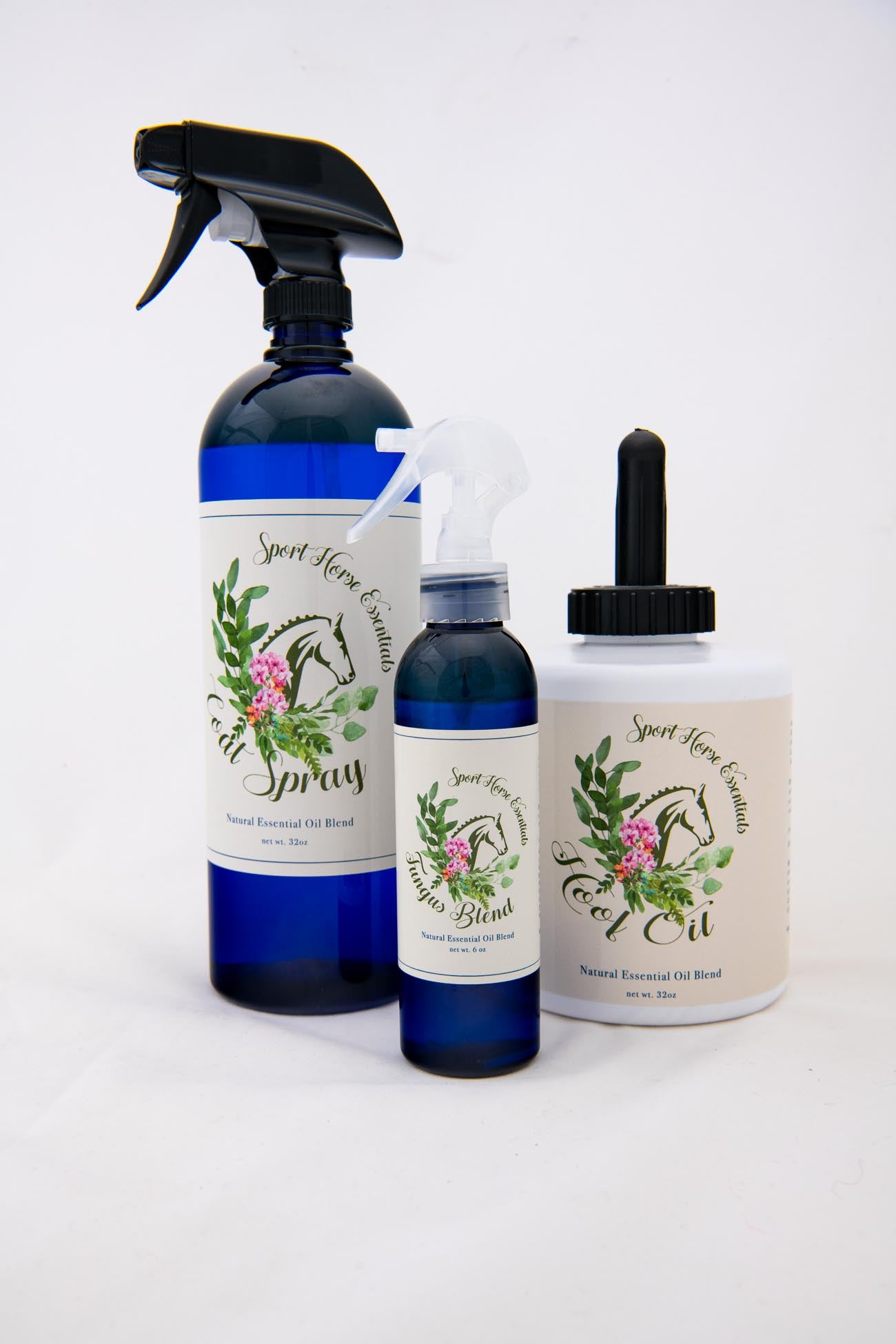
The SHE Shine Package
$138 $124
Coat quality doesn't stop at the coat. This bundles the Coat Spray with Hoof Oil and the Fungus & Wound Blend, so the whole horse is covered by one routine rather than three separate decisions.
- Coat Spray for daily shine and skin conditioning
- Hoof Oil to condition hooves and treat thrush at the source
- Fungus & Wound Blend for cuts, rain rot, and hair regrowth
